AI TL;DR
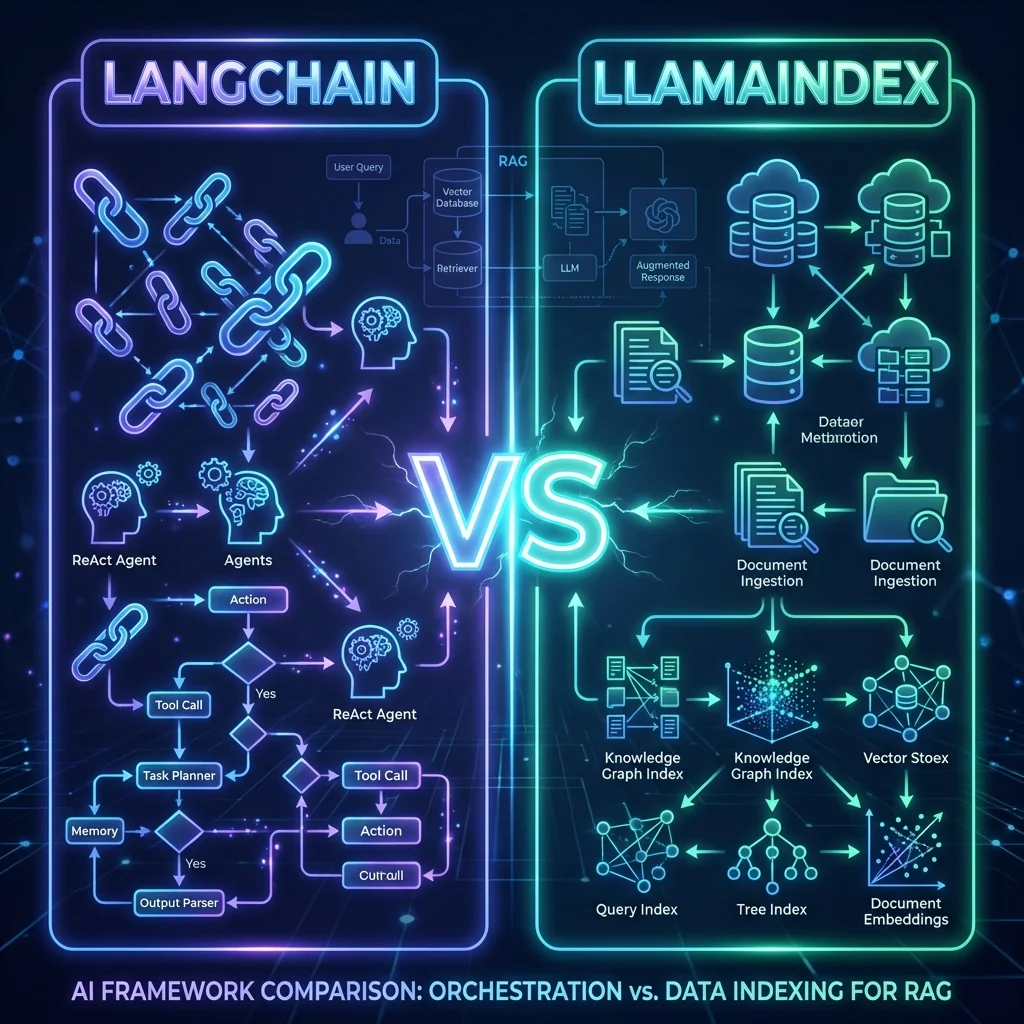
Choosing between LangChain and LlamaIndex for your RAG and LLM apps? Here's a complete breakdown of features, architecture, and when to use each framework.
LangChain vs LlamaIndex: Which AI Framework Should You Choose? (2026)
Building with Large Language Models? You'll likely encounter two frameworks: LangChain and LlamaIndex.
Both are open-source, both simplify LLM development, but they solve different problems. After building production systems with each, here's what you need to know.
Quick Comparison
| Aspect | LangChain | LlamaIndex |
|---|---|---|
| Primary Focus | Orchestration & agents | Data indexing & RAG |
| Best For | Complex workflows | Knowledge bases |
| GitHub Stars | ~85,000 | ~30,000 |
| Learning Curve | Steeper (more abstractions) | Gentler (data-focused) |
| Agent Capabilities | ✅ Highly developed | ⚠️ Growing |
| Data Connectors | Good (common formats) | ✅ Excellent (150+) |
The Hybrid Approach: Many production apps use both — LlamaIndex for data, LangChain for orchestration.
LangChain: The Orchestration Engine
What Is LangChain?
LangChain is a "Swiss Army knife" framework for building diverse LLM applications. It excels at:
- Orchestrating multi-step workflows
- Creating autonomous AI agents
- Managing conversational memory
- Connecting LLMs to external tools
Think of it as the orchestration layer for your AI app.
Core Strengths (2026)
1. Agentic AI - LangChain's killer feature
- Tools Agents that call APIs dynamically
- ReAct agents for reasoning + acting
- Plan-and-Execute agents for complex tasks
2. Modularity - Mix and match 700+ components:
- Multiple LLM integrations (OpenAI, Anthropic, Google)
- Memory systems (conversation buffers, summaries)
- Tool integrations (web search, calculators, databases)
3. LangSmith - Production observability:
- Trace every LLM call
- Debug multi-step chains
- Evaluate model performance
When to Choose LangChain
- ✅ Complex chatbots with multi-turn conversations
- ✅ Task automation where AI decides next steps
- ✅ Multi-tool integration (web scraping + database + API calls)
- ✅ Dynamic workflows that change based on LLM output
LangChain Pricing
- Framework: Free (open-source)
- LangSmith (Observability):
- Developer: Free (limited traces)
- Plus: $39/month
- Enterprise: Custom
LlamaIndex: The Data Framework
What Is LlamaIndex?
LlamaIndex (formerly GPT Index) is laser-focused on connecting LLMs to your data. It specializes in:
- Ingesting documents at scale
- Creating sophisticated indices
- Optimizing retrieval for RAG
- Building queryable knowledge bases
Think of it as the knowledge layer for your AI app.
Core Strengths (2026)
1. Advanced Indexing - Multiple strategies:
- Tree-based indices for hierarchical data
- Keyword indices for fast lookup
- Knowledge graph indices for relationships
- Vector indices for semantic search
2. Data Connectors - 150+ via LlamaHub:
- PDFs, Word docs, spreadsheets
- Databases (Postgres, MySQL, MongoDB)
- APIs (Notion, Google Drive, Slack)
- Web scrapers
3. RAG Optimization - Built for retrieval:
- Semantic chunking (overlap optimization)
- 30-40% token reduction through targeted retrieval
- Reranking and post-processing
- Evaluation primitives
2026 Updates
🆕 LlamaParse v2 - Faster, cheaper document parsing
🆕 LlamaSheets (Beta) - Handle messy spreadsheets
🆕 Agentic RAG - Growing agent capabilities with Workflow class
When to Choose LlamaIndex
- ✅ Document-heavy apps (knowledge bases, search)
- ✅ RAG-first systems where accuracy matters
- ✅ Data indexing at scale (thousands of documents)
- ✅ Custom data sources needing specialized connectors
LlamaIndex Pricing
- Framework: Free (open-source)
- LlamaCloud (Managed):
- Starter: Free tier available
- Pro: Custom pricing
- Enterprise: Contact sales
Head-to-Head: RAG Implementation
Let's compare how each handles Retrieval-Augmented Generation:
| Aspect | LangChain | LlamaIndex |
|---|---|---|
| Indexing | Manual composition needed | "Batteries included" primitives |
| Retrieval | Flexible but requires setup | Optimized out-of-box |
| Token Efficiency | Standard | 30-40% reduction |
| Data Connectors | Common formats | 150+ specialized |
| Evaluation | Via LangSmith | Built-in eval primitives |
Winner: LlamaIndex for pure RAG, LangChain for RAG + complex workflows
Feature Comparison
Agent Capabilities
| Feature | LangChain | LlamaIndex |
|---|---|---|
| Maturity | ✅ Highly developed (core feature) | ⚠️ Growing (Workflow class) |
| Use Cases | Complex multi-tool orchestration | Data retrieval with reasoning |
| Tool Use | Extensive library | Emerging |
Winner: LangChain (but LlamaIndex catching up in 2026)
Data Handling
| Feature | LangChain | LlamaIndex |
|---|---|---|
| Document Loaders | Good (common formats) | ✅ Excellent (150+ connectors) |
| Chunking | Basic splitting | ✅ Semantic chunking |
| Index Types | Vector-focused | ✅ Multiple strategies |
Winner: LlamaIndex
Community & Ecosystem
| Aspect | LangChain | LlamaIndex |
|---|---|---|
| GitHub Stars | ~85,000 | ~30,000 |
| Community | Broader, general LLM | Focused on RAG/data |
| Integrations | 700+ components | 150+ data connectors |
| Documentation | Extensive | Growing |
Winner: LangChain (larger ecosystem)
The Hybrid Approach (Recommended)
Most production systems use both frameworks together:
LlamaIndex → Knowledge Layer (data ingestion, indexing, retrieval)
      ↓
LangChain → Orchestration Layer (workflows, agents, tools)
Why This Works
| Layer | Framework | Role |
|---|---|---|
| Data | LlamaIndex | Ingest docs, create indices, optimize retrieval |
| Orchestration | LangChain | Multi-step logic, agent decisions, tool use |
Example: Customer support AI
- LlamaIndex indexes help docs, FAQs, past tickets
- LangChain orchestrates: retrieve context → generate response → call CRM API
Real-World Scenarios
Scenario 1: Legal Document Search
Requirements: Search 10,000+ legal documents, cite sources
Best Choice: LlamaIndex
- Advanced indexing for massive document sets
- Knowledge graph for legal relationships
- Citation tracking built-in
Scenario 2: AI Sales Assistant
Requirements: Multi-tool (CRM, email, calendar, web search), autonomous
Best Choice: LangChain
- Agent decides which tool to use
- Multi-step reasoning (research → draft → send)
- Conversation memory across sessions
Scenario 3: Enterprise Knowledge Base
Requirements: Internal docs + databases, accurate answers, scale
Best Choice: Hybrid (LlamaIndex + LangChain)
- LlamaIndex: Index all company data
- LangChain: Orchestrate retrieval + formatting + tool calls
Migration Considerations
From LangChain to LlamaIndex
- ✅ Keep LangChain for orchestration
- ✅ Add LlamaIndex for data layer
- ⚠️ Don't replace — complement!
From LlamaIndex to LangChain
- ✅ Keep LlamaIndex for RAG
- ✅ Add LangChain for agents
- ⚠️ Again — hybrid is best!
The Verdict
| If You're Building... | Choose |
|---|---|
| Complex chatbots with tools | LangChain |
| Document search systems | LlamaIndex |
| Autonomous AI agents | LangChain |
| Knowledge bases at scale | LlamaIndex |
| Multi-step workflows | LangChain |
| RAG with custom data sources | LlamaIndex |
| Production enterprise AI | Both (Hybrid) |
My Recommendation: Start with your primary need:
- Data-heavy? → LlamaIndex first, add LangChain for workflows
- Agent-heavy? → LangChain first, add LlamaIndex for knowledge
Most mature systems use both.
FAQ
Can I use them together?
Yes! This is the recommended approach for production. LlamaIndex handles data, LangChain handles orchestration.
Which is easier to learn?
LlamaIndex has a gentler curve for data-focused tasks. LangChain's breadth makes it steeper initially.
Do I need both?
Not always. Simple RAG → LlamaIndex. Simple chatbots → LangChain. Complex production apps → both.
Which is faster?
LlamaIndex optimizes for retrieval speed (30-40% token reduction). LangChain focuses on flexibility over speed.
Related Tools
- LangGraph – LangChain's graph-based orchestration
- Haystack – Alternative NLP framework
- n8n – Workflow automation with AI
Last updated: January 2026