AI TL;DR
OpenAI has phased out GPT-4 from ChatGPT, replacing it with GPT-4o and introducing powerful reasoning models like o3 and o4-mini. Here's what developers and users need to know about the transition.
GPT-4 Retirement: OpenAI's Model Transition and What It Means for Developers
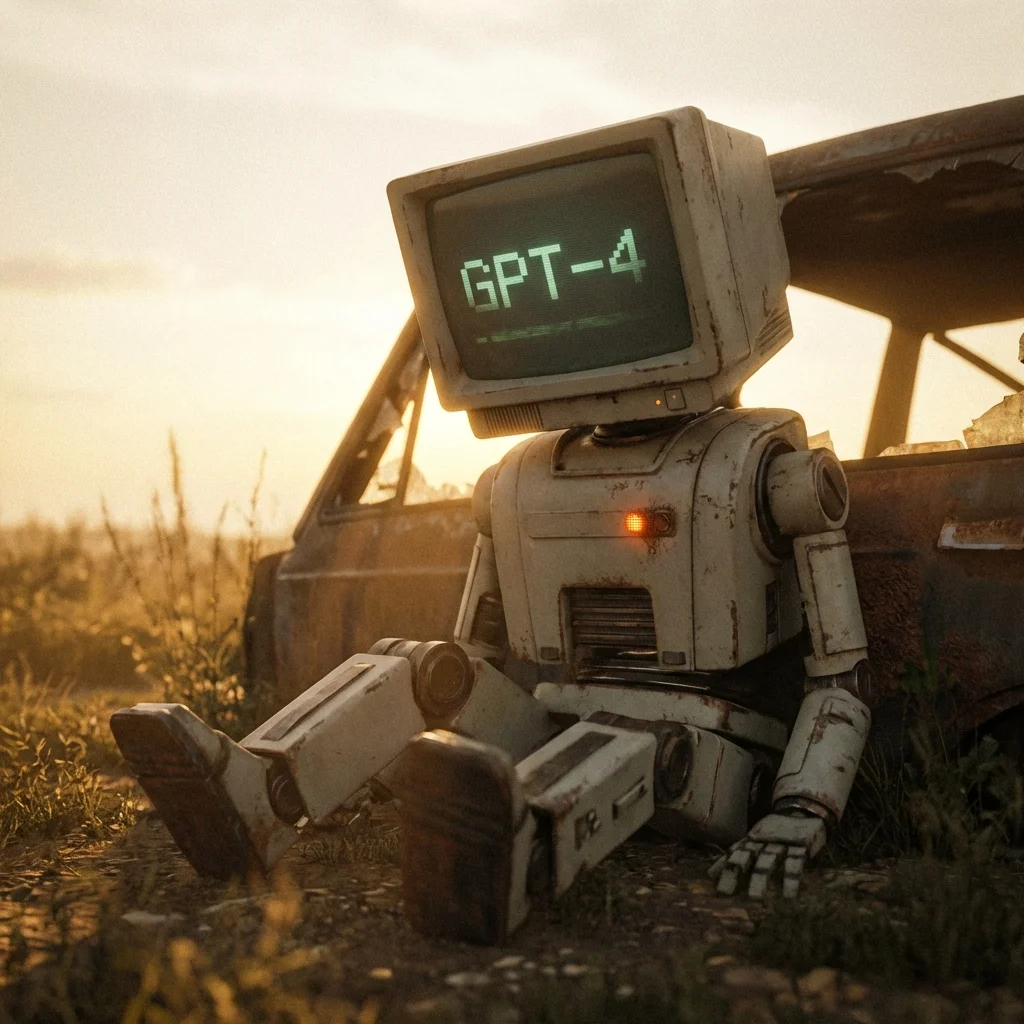
In April 2025, OpenAI announced a significant milestone in its model evolution: the retirement of GPT-4 from ChatGPT, marking the end of an era for one of the most influential AI models in history. The transition reflects OpenAI's accelerating pace of innovation and its strategic shift toward more capable, multimodal, and reasoning-focused AI systems.
The End of GPT-4 in ChatGPT
According to OpenAI's official changelog released on April 11, 2025, GPT-4 was "fully replaced" by GPT-4o effective April 30, 2025. This wasn't a sudden discontinuation—it was a calculated transition that OpenAI had been preparing for nearly a year.
Key Details of the Retirement:
- Effective Date: April 30, 2025
- Replacement Model: GPT-4o (released May 2024)
- API Access: GPT-4 remains available via OpenAI's API
- ChatGPT Default: GPT-4o became the standard model
In their announcement, OpenAI stated: "In head‑to‑head evaluations, [GPT-4o] consistently surpasses GPT‑4 in writing, coding, STEM, and more. Recent upgrades have further improved GPT‑4o's instruction following, problem solving, and conversational flow, making it a natural successor to GPT‑4."
GPT-4: A Legacy of Innovation
To understand the significance of this transition, we need to appreciate what GPT-4 represented when it launched in March 2023.
The GPT-4 Era (2023-2025)
Training Investment: According to Sam Altman, GPT-4 cost more than $100 million to train—a staggering investment that set new benchmarks for AI development.
Groundbreaking Capabilities:
- First widely deployed OpenAI model with multimodal capabilities (text + images)
- Powered both ChatGPT and Microsoft's Copilot
- Enabled new applications in education, creative work, and enterprise
Industry Impact:
- Sparked the generative AI gold rush
- Led to massive enterprise adoption
- Became central to copyright disputes with publishers including The New York Times
Evolution Path:
- March 2023: GPT-4 launch
- November 2023: GPT-4 Turbo (faster, cheaper)
- May 2024: GPT-4o (multimodal "omni" model)
- April 2025: GPT-4 retirement from ChatGPT
GPT-4o: The New Standard
GPT-4o, where "o" stands for "omni," represents a fundamental architectural shift in how OpenAI builds AI models.
What Makes GPT-4o Different
End-to-End Multimodal Training: Unlike GPT-4's pipeline approach (separate models for transcription, processing, and output), GPT-4o was trained as a single model across text, vision, and audio. This means:
- All inputs and outputs processed by the same neural network
- Direct observation of tone, emotion, and audio nuances
- Real-time responsiveness (232-320 millisecond average response time)
Performance Improvements:
- 2x faster than GPT-4 Turbo
- 50% cheaper in the API
- 5x higher rate limits
- Enhanced performance in 50+ languages
Voice Capabilities: GPT-4o enables truly conversational AI with:
- Natural interruption handling
- Emotional expression (including singing)
- Real-time translation
- Background noise awareness
ChatGPT User Experience
For ChatGPT users, the GPT-4o transition brought:
- Faster, more natural conversations
- Improved vision analysis (menus, screenshots, documents)
- Better multilingual support
- Enhanced memory and personalization
The Rise of Reasoning Models: o3 and o4-mini
The GPT-4 retirement coincided with OpenAI's aggressive push into "reasoning" models—a new class of AI that thinks longer and more deliberately before responding.
o3: OpenAI's Most Powerful Reasoning Model
Released in April 2025, o3 represents the cutting edge of AI reasoning:
Key Capabilities:
- Multimodal reasoning across text, images, and tools
- State-of-the-art performance on coding, math, science, and visual perception
- 20% fewer major errors than o1 on difficult real-world tasks
- Can integrate images directly into chain-of-thought reasoning
Benchmark Performance:
- New SOTA on Codeforces competitive programming
- New SOTA on SWE-bench software engineering
- New SOTA on MMMU multimodal understanding
- 98.4% pass@1 on AIME 2025 math competition (with tool access)
Tool Integration: o3 can agentically use all ChatGPT tools:
- Web search
- Python code execution
- Image generation and manipulation
- File analysis
- Custom function calling
o4-mini: Fast, Efficient Reasoning
For cost-sensitive applications, o4-mini offers remarkable capability:
Performance Highlights:
- Best-performing benchmarked model on AIME 2024 and 2025
- 99.5% pass@1 on AIME 2025 (with Python interpreter)
- Outperforms predecessor o3-mini on STEM and non-STEM tasks
- Significantly higher usage limits than o3
Ideal Use Cases:
- High-volume reasoning applications
- Cost-efficient math and coding tasks
- Fast turnaround requirements
- Development and testing environments
Thinking with Images
A breakthrough capability of o3 and o4-mini is their ability to integrate images into reasoning:
"For the first time, these models can integrate images directly into their chain of thought. They don't just see an image—they think with it."
This enables:
- Analysis of whiteboards and hand-drawn sketches
- Textbook diagram interpretation
- On-the-fly image manipulation during reasoning
- Best-in-class visual perception accuracy
The GPT-4.1 Family
Alongside reasoning models, OpenAI introduced the GPT-4.1 series in early 2025:
GPT-4.1 Variants:
- GPT-4.1 (full capability)
- GPT-4.1-mini (balanced)
- GPT-4.1-nano (lightweight)
These models bridge the gap between GPT-4o and specialized reasoning models, offering developers flexible options for different application requirements.
Developer Transition Guide
For developers currently using GPT-4 in their applications, here's a comprehensive migration strategy:
API Access Status
| Model | ChatGPT | API | Status |
|---|---|---|---|
| GPT-4 | Retired | Available | Legacy support |
| GPT-4 Turbo | Retired | Available | Legacy support |
| GPT-4o | Default | Available | Recommended |
| GPT-4o-mini | Available | Available | Cost-efficient |
| GPT-4.1 | Available | Available | Latest GPT series |
| o3 | Available | Available | Advanced reasoning |
| o4-mini | Available | Available | Fast reasoning |
Migration Recommendations
For ChatGPT Integration:
// Before (GPT-4)
const response = await openai.chat.completions.create({
  model: "gpt-4",
  messages: [{ role: "user", content: prompt }]
});

// After (GPT-4o - recommended)
const response = await openai.chat.completions.create({
  model: "gpt-4o",
  messages: [{ role: "user", content: prompt }]
});

// For reasoning tasks
const response = await openai.chat.completions.create({
  model: "o4-mini",  // or "o3" for complex reasoning
  messages: [{ role: "user", content: prompt }]
});
Choosing the Right Model:
| Use Case | Recommended Model | Rationale |
|---|---|---|
| General chat | GPT-4o | Balanced performance and cost |
| High-volume | GPT-4o-mini | Cost-efficient |
| Complex reasoning | o3 | Highest accuracy |
| Fast reasoning | o4-mini | Speed + capability |
| Coding tasks | o3 or o4-mini | Superior code generation |
| Image analysis | GPT-4o or o3 | Multimodal optimization |
| Legacy compatibility | GPT-4 (API) | Existing workflows |
Cost Considerations
OpenAI's newer models generally offer better cost-performance ratios:
GPT-4o Advantages:
- 50% cheaper than GPT-4 Turbo
- 2x faster inference
- Higher rate limits
o3/o4-mini Efficiency:
- Better performance at equivalent cost points
- o4-mini particularly efficient for math and coding
- Strictly improved cost-performance frontier over predecessors
Handling Breaking Changes
Potential Issues:
- Response Format Differences: GPT-4o may structure responses differently
- Token Counting: New tokenizer may affect billing
- Behavior Changes: Improved instruction following may affect prompts
Mitigation Strategies:
- Test thoroughly before migration
- Update prompts to leverage new capabilities
- Monitor costs during transition period
- Use version pinning for critical applications
The Broader OpenAI Roadmap
The GPT-4 retirement is part of OpenAI's larger strategic evolution:
Converging Model Families
OpenAI has signaled its intent to merge the strengths of:
- GPT series: Natural conversation and broad capability
- O series: Deep reasoning and problem-solving
"We're converging the specialized reasoning capabilities of the o-series with more of the natural conversational abilities and tool use of the GPT‑series."
GPT-5: The Unified Future
Sam Altman has outlined plans for GPT-5 as a unified model:
Planned Features:
- Integrated reasoning capabilities
- Voice, Canvas, search, and deep research
- Unlimited chat at "standard intelligence setting"
- Variable intelligence levels for Plus and Pro users
Timeline:
- Originally planned for early 2025
- Delayed to incorporate o-series insights
- Expected "in a few months" (as of April 2025)
Hardware and Infrastructure
OpenAI is making massive infrastructure investments:
Recent Deals:
- $10B Cerebras computing partnership (January 2026)
- Amazon investment discussions ($50B, January 2026)
- Nvidia $100B investment negotiations
- Microsoft data center expansion partnership
Enterprise Focus
2026 has seen OpenAI aggressively pursuing enterprise customers:
Enterprise Products:
- Prism: AI workspace for scientists (January 2026)
- Specialized AI agents (up to $20,000/month pricing)
- ChatGPT Enterprise enhancements
- Healthcare integrations (Torch acquisition, bwell partnership)
Industry Implications
The GPT-4 retirement has broader implications for the AI industry:
For Developers
Opportunities:
- Access to more capable models at lower costs
- New reasoning capabilities for complex applications
- Better multimodal integration possibilities
Challenges:
- Keeping up with rapid model changes
- Migration and testing overhead
- Uncertainty about future deprecations
For Enterprises
Considerations:
- Long-term model stability planning
- Cost modeling with newer, more efficient models
- Competitive advantage through early adoption
For Competitors
The retirement signals OpenAI's confidence and aggressive pace:
Competitive Pressure:
- DeepSeek and open-source alternatives gaining ground
- Anthropic Claude continuing advancement
- Google Gemini improving capabilities
Open Model Strategy: OpenAI has announced plans for its first open language model since GPT-2, potentially shifting competitive dynamics.
Codex CLI: Developer Tools Evolution
Alongside model updates, OpenAI released Codex CLI, demonstrating their commitment to developer experience:
Features:
- Terminal-based coding agent
- Direct computer access
- Multimodal reasoning from command line
- Open-source at github.com/openai/codex
Funding Program: $1 million initiative for projects using Codex CLI, with $25,000 grants in API credits.
Safety and Governance
The new models come with enhanced safety measures:
Safety Training
Rebuilt Safety Data:
- New refusal prompts for biorisk, malware, jailbreaks
- Strong performance on instruction hierarchy
- Reasoning LLM monitor for dangerous prompts
Biorisk Protection: ~99% of dangerous conversations flagged by AI monitor in red-teaming campaigns.
Preparedness Framework
Both o3 and o4-mini evaluated against:
- Biological and chemical risks
- Cybersecurity threats
- AI self-improvement capabilities
Result: Below "High" threshold in all categories, meeting deployment requirements.
Looking Forward: What to Expect
Near-Term (Q1-Q2 2026)
- o3-pro release with full tool support
- GPT-5 potential release
- Expanded Codex CLI capabilities
- Continued enterprise product development
Medium-Term (2026-2027)
- Model family unification
- More efficient inference
- Enhanced agentic capabilities
- Broader industry-specific applications
Long-Term Trends
- Convergence of reasoning and conversation
- Increasing tool use and agency
- More specialized model variants
- Greater integration with hardware and infrastructure
Conclusion
The retirement of GPT-4 from ChatGPT marks more than a simple model update—it represents OpenAI's evolution from single breakthrough models to a sophisticated ecosystem of specialized AI systems. GPT-4o brings multimodal excellence, the o-series delivers unprecedented reasoning capabilities, and the upcoming unified models promise to combine the best of both worlds.
For developers and enterprises, the key takeaway is clear: AI capabilities are advancing faster than ever, and staying current requires active engagement with new models, architectures, and capabilities. The GPT-4 era gave us the foundation; what comes next promises to redefine what AI can accomplish.
Key Takeaways
- GPT-4 retired from ChatGPT on April 30, 2025, replaced by GPT-4o
- GPT-4 remains available via API for legacy applications
- GPT-4o offers 2x speed, 50% lower cost than GPT-4 Turbo
- o3 and o4-mini provide advanced reasoning with tool integration
- GPT-5 coming as unified model with integrated reasoning
- Developers should migrate to GPT-4o or newer models
- Enterprise focus increasing with specialized products
The AI model landscape continues to evolve rapidly. Stay tuned to PromptGalaxy for the latest updates on OpenAI and other AI developments.