AI TL;DR
OpenAI and Anthropic both launched healthcare AI within days of each other. Here's how ChatGPT Health and Claude Healthcare compare for patients and providers.
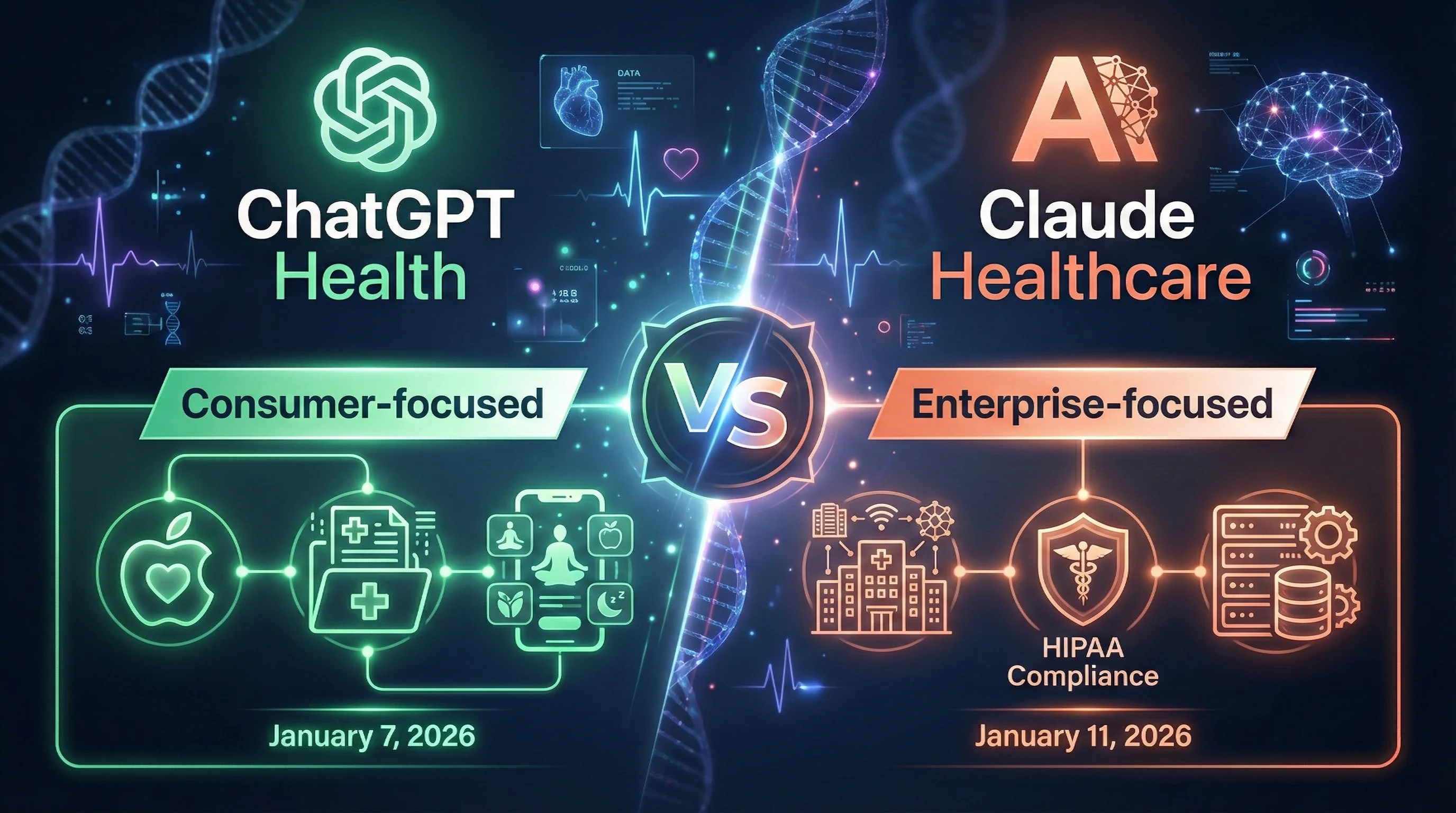
The AI healthcare race just heated up. Within four days of each other in January 2026, both OpenAI and Anthropic launched dedicated healthcare products:
- January 7, 2026: OpenAI unveils ChatGPT Health
- January 11, 2026: Anthropic releases Claude Healthcare
These aren't just marketing updates—they represent fundamentally different approaches to AI in medicine. Let's break down which one might be right for you.
The Key Difference: Consumer vs. Enterprise
The most important distinction between these platforms comes down to who they're built for:
| Aspect | ChatGPT Health | Claude Healthcare |
|---|---|---|
| Primary Focus | Consumers (patients) | Enterprise (hospitals, providers) |
| Main Goal | Personal health insights | Workflow automation |
| Target User | Individual patients | Healthcare organizations |
| Pricing | Part of ChatGPT subscription | Enterprise licensing |
| Launch Date | January 7, 2026 | January 11, 2026 |
ChatGPT Health: Your Personal Health Assistant
OpenAI designed ChatGPT Health to be a consumer-facing personal health companion. It's like having a knowledgeable friend who can help you understand your health data.
Key Features
1. Medical Record Integration
- Connect your medical records securely via b.well
- Upload lab results, visit summaries, and health documents
- ChatGPT can reference your actual health history in conversations
2. Wellness App Connections
- Apple Health: Syncs activity, sleep, heart rate data
- MyFitnessPal: Nutrition and calorie tracking
- Function: Biomarker and health metrics
- More integrations coming soon
3. Personalized Health Insights
- Ask questions about YOUR lab results
- Get context-aware health advice
- Prepare questions for doctor's appointments
- Diet and exercise recommendations based on your data
4. Privacy Protections
- Purpose-built encryption for health conversations
- Isolated storage (separate from regular chats)
- Health data NOT used to train AI models
- Explicit opt-in required to share health info
Example Use Cases
"My cholesterol came back at 245. What does this mean, and what questions should I ask my doctor?"
"Based on my Apple Health data, am I getting enough sleep? What's my trend over the past month?"
"I'm training for a marathon. Given my fitness data, can you suggest a weekly training plan?"
Who Should Use ChatGPT Health?
- Patients who want to understand their health data better
- People preparing for doctor's appointments
- Fitness enthusiasts tracking wellness metrics
- Anyone who wants AI help interpreting lab results
Claude Healthcare: Built for Hospitals
Anthropic took a completely different approach. Claude Healthcare is designed for enterprise healthcare organizations, not individual patients.
Key Features
1. HIPAA-Ready Infrastructure
- Built from the ground up for compliance
- Secure handling of patient data at scale
- Enterprise-grade security and audit trails
2. Clinical Data Source Integration
- CMS Coverage Database: Medicare/Medicaid coverage policies
- ICD-10 Coding Systems: Billing and diagnostic codes
- PubMed: Medical research and citations
- Clinical Guidelines: Treatment protocols
3. Administrative Workflow Automation
- Speeds up prior authorization requests
- Supports claims appeals with documentation
- Pulls information from multiple regulatory sources
- Reduces administrative burden on staff
4. Consumer EHR Features
- Patients can connect Apple Health or Android Health Connect
- AI explains electronic health records in plain language
- Helps patients understand care instructions
Example Enterprise Use Cases
"Review this prior authorization request and check it against CMS coverage policies."
"Generate a claims appeal letter using the patient's medical history and relevant clinical guidelines."
"Summarize the latest PubMed research on treatment options for this diagnosis."
Who Should Use Claude Healthcare?
- Hospitals and health systems
- Insurance companies handling claims
- Medical practices streamlining admin work
- Healthcare IT teams building AI-powered tools
Head-to-Head Comparison
| Feature | ChatGPT Health | Claude Healthcare |
|---|---|---|
| Consumer App | ✅ Full consumer focus | ⚠️ Limited patient features |
| Enterprise Tools | ⚠️ Limited | ✅ Full enterprise focus |
| Medical Records | ✅ Via b.well | ✅ EHR integration |
| Wellness Apps | ✅ Apple Health, MyFitnessPal | ✅ Apple Health, Android Health |
| HIPAA Compliance | ✅ Enhanced protections | ✅ Enterprise HIPAA-ready |
| Clinical Databases | ❌ Limited | ✅ CMS, ICD-10, PubMed |
| Admin Automation | ❌ Not designed for this | ✅ Core feature |
| Doctor Collaboration | ✅ 260+ physicians involved | ✅ Healthcare org partnerships |
| Availability | ⚠️ Limited rollout (not EU/UK) | ✅ Enterprise customers |
Medical Accuracy: How Do They Compare?
Independent studies suggest Claude may have an edge in complex medical scenarios. In one study comparing earlier versions of these models:
- Claude: Correctly diagnosed 62% of difficult radiology cases
- GPT-4: Correctly diagnosed 49% of the same cases
However, both companies emphasize that their AI is meant to support, not replace professional medical care. Neither should be used for emergency situations or as a substitute for seeing a doctor.
Privacy and Data Security
Both platforms take health data privacy seriously, but with different approaches:
ChatGPT Health Privacy
- Health conversations use dedicated encryption
- Health data stored separately from regular chats
- Not used for model training
- Users must explicitly opt-in to share health info
- Currently not available in EU, UK, or Switzerland
Claude Healthcare Privacy
- HIPAA-ready infrastructure for enterprises
- Designed for healthcare compliance from day one
- Patient data handled with enterprise security
- Organizations control data retention policies
Which One Should You Choose?
Choose ChatGPT Health if:
- ✅ You're an individual patient wanting to understand your health
- ✅ You want to connect fitness apps for personalized insights
- ✅ You need help preparing for doctor's appointments
- ✅ You want AI to explain lab results in plain language
- ✅ You're already a ChatGPT Plus or Pro subscriber
Choose Claude Healthcare if:
- ✅ You're a healthcare organization looking to reduce admin work
- ✅ You need HIPAA-compliant AI infrastructure
- ✅ You want to speed up prior authorizations and claims appeals
- ✅ You need integration with clinical databases (CMS, ICD-10)
- ✅ You're building healthcare AI applications for providers
Use Both if:
You're a healthcare provider who wants Claude for administrative work AND recommends ChatGPT Health to patients for personal wellness tracking.
The Bigger Picture: AI Healthcare in 2026
The near-simultaneous launch of ChatGPT Health and Claude Healthcare signals that AI healthcare features are becoming table stakes. Key trends to watch:
- Personalization: AI that actually knows your health history
- Integration: Seamless connections with health apps and records
- Compliance: HIPAA and privacy-first design
- Specialization: Consumer AI vs. enterprise AI diverging
Google is also in this race with MedGemma 1.5, their open medical AI models for developers building clinical tools. The healthcare AI market is getting crowded fast.
Important Warnings
Both OpenAI and Anthropic are clear about the limitations:
⚠️ These AI tools are NOT a replacement for professional medical care
⚠️ Do not use for medical emergencies—call 911 or go to the ER
⚠️ Always verify AI suggestions with your healthcare provider
⚠️ AI can make mistakes—human oversight is essential
The Bottom Line
For patients: ChatGPT Health is the clear winner. It's designed specifically to help you understand your health data, prepare for appointments, and get personalized wellness insights.
For healthcare organizations: Claude Healthcare offers more robust enterprise features, HIPAA compliance, and clinical database integrations that ChatGPT Health simply doesn't have.
The best news? Competition between OpenAI and Anthropic in healthcare means both products will continue improving rapidly. By mid-2026, we'll likely see even more powerful features from both platforms.
Frequently Asked Questions
When did ChatGPT Health launch?
ChatGPT Health was announced on January 7, 2026, with a limited rollout to select users.
When did Claude Healthcare launch?
Claude Healthcare was released on January 11, 2026, just four days after ChatGPT Health.
Is ChatGPT Health available everywhere?
No. It's currently not available in the EU, UK, or Switzerland due to regulatory considerations.
Do I need to pay extra for ChatGPT Health?
ChatGPT Health features are included with ChatGPT Plus and Pro subscriptions.
Can I use these AI tools instead of seeing a doctor?
No. Both OpenAI and Anthropic emphasize that their AI is meant to support, not replace, professional medical care.
Which AI is more accurate for medical questions?
Studies suggest Claude may be slightly more accurate on complex medical cases, but both are capable and continue to improve.
Last updated: January 19, 2026