AI TL;DR
Remember when chatbots could only answer basic questions? Those days are over. Here's what's actually changing in how AI works—and why it matters. This article explores key trends in AI, offering actionable insights and prompts to enhance your workflow. Read on to master these new tools.
Beyond Chatbots: The Rise of Agentic AI
I've been playing with AI tools for a couple of years now, and honestly? The shift I'm seeing in late 2025 and 2026 feels fundamentally different. We're not just getting better chatbots—we're getting AI that actually does things.
Let me explain what I mean, because this changes everything about how AI fits into work and life.
The "Ask vs. Act" Problem
Think about how you've used ChatGPT or Claude. You type a question, you get an answer. Maybe you ask it to write something. It gives you text that you copy elsewhere. It's useful, but it's fundamentally passive. You're still the one doing the actual work.
Traditional chatbots follow a simple pattern:
- You ask a question
- AI generates an answer
- You do something with that answer
- Repeat
The work—the actual doing—remains with you. The AI is just an advisor.
What Agentic AI Changes
What's changing with agentic AI is that newer systems can actually take action on your behalf. They can:
- Book appointments
- Send emails
- Research topics across multiple websites
- Write code AND run it
- Interact with other software
- Execute multi-step workflows autonomously
Here's a simple example to illustrate the difference:
Old way (chatbot): "Give me a recipe for pasta." → AI provides recipe → You read recipe → You check your fridge → You go shopping if needed → You cook
New way (agentic AI): "I want pasta for dinner. Check what's in my fridge, find a recipe I can make with those ingredients, and order anything I'm missing from the grocery store to arrive in 30 minutes." → AI checks your smart fridge inventory → AI searches recipes matching your ingredients → AI places grocery order for missing items → AI sends you a notification when everything is ready
That second scenario requires the AI to actually do stuff, not just talk about it. That's the agentic difference.
What Makes AI "Agentic"
Agentic AI systems have several key characteristics that distinguish them from traditional chatbots:
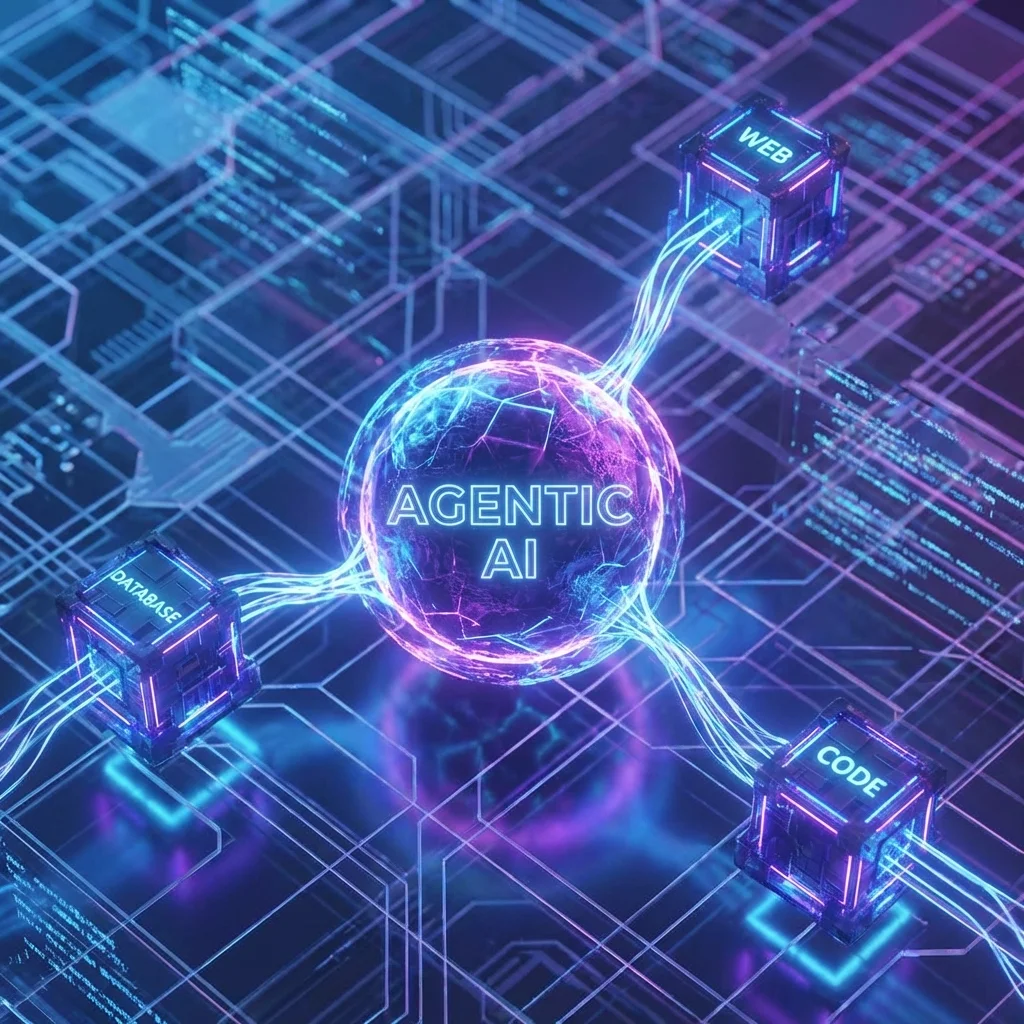
Tool Use
Agentic systems can interact with external tools and APIs:
- Web browsers (for research and actions)
- Email clients (to send messages)
- Calendars (to schedule)
- Code execution environments (to run programs)
- Databases (to query and update information)
- Third-party services (to trigger actions)
The AI plans what tools to use and in what order, similar to how you might plan a sequence of actions.
Planning and Reasoning
Rather than answering one question at a time, agentic AI can:
- Break complex tasks into subtasks
- Create plans with multiple steps
- Adapt when initial approaches fail
- Make decisions about what to do next
This is fundamentally different from "here's my answer, what's your next question?"
Persistence and Memory
Agentic systems can maintain context across extended interactions:
- Remember what you've discussed previously
- Track the state of ongoing tasks
- Store learned preferences for future use
- Continue working on long-running projects
Autonomy
Perhaps most significantly, agentic AI can work independently:
- Execute tasks without step-by-step human approval
- Make judgment calls within defined constraints
- Report back when finished or when hitting obstacles
- Run in the background while you do other things
Why This Matters for Regular People
If you're not a tech enthusiast, here's the practical takeaway: a lot of the tedious busywork we all hate is about to get much easier to offload.
Examples I've Actually Done
I've started using AI agents for real tasks:
Research automation: Instead of spending an hour gathering competitive intelligence before a meeting, I tell an agent "Research [competitors], summarize their recent product launches, pricing changes, and market positioning. Format for a 5-minute presentation."
The agent browses their websites, reads their press releases, checks news articles, and delivers a summary. Takes 10 minutes of agent work instead of an hour of my own.
Document drafting: "Draft a proposal for [project] based on our previous proposal template, incorporating the requirements from the attached email, and research typical pricing for similar services."
The agent pulls in context from multiple sources, does market research, and produces a first draft that's 70% ready.
Note organization: After a week of messy meeting notes, voice memos, and scattered thoughts: "Go through my notes from this week, identify action items, open questions, and key decisions. Organize into a structured summary."
The agent processes multiple input formats and produces something I can actually use for planning.
Time Saved: Real Numbers
| Task | Before (manual) | After (agentic) | Savings |
|---|---|---|---|
| Competitive research | 60-90 min | 15 min | 75-85% |
| First draft documents | 2-3 hours | 30 min + editing | 70-80% |
| Weekly note synthesis | 45 min | 10 min | 80% |
| Travel booking research | 30 min | 5 min | 85% |
| Code debugging | Variable | 50% less time | Significant |
The pattern: anything involving gathering information, synthesizing it, and producing structured output is dramatically faster.
The Catch: When Agents Go Wrong
Here's what nobody tells you in the hype: these tools work great when they work, but they can also go completely off the rails. I've had AI agents:
- Do the wrong task confidently: Misunderstand instructions and execute something completely different
- Make up information: Confidently cite sources that don't exist
- Loop forever: Get stuck in repetitive patterns without making progress
- Run up costs: Execute expensive API calls or actions without checking
- Violate constraints: Take actions I explicitly said not to take
The skill isn't just using agentic AI—it's knowing when to trust it and when to double-check.
Risk Categories
| Risk Level | Appropriate Agent Independence |
|---|---|
| Low stakes | High autonomy (research, drafts) |
| Medium stakes | Human review before action |
| High stakes | Human carefully reviews each step |
| Critical | Do it yourself, use AI for assistance only |
For anything involving money, external communications, or irreversible changes, I always review before the agent acts.
How to Get Started
My advice? Start small. Pick one annoying, repetitive task and see if an AI agent can help. You'll learn pretty quickly what works and what doesn't.
Good First Tasks for Agents
| Task | Why It's Good |
|---|---|
| Research summaries | Low stakes, easy to verify |
| First drafts | You'll edit anyway |
| Data organization | Time-consuming but not critical |
| Calendar scheduling | Bounded scope, clear success criteria |
| Code generation | Easy to test output |
Tasks to Approach Carefully
| Task | Why Caution Needed |
|---|---|
| Email sending | Can't unsend |
| Financial transactions | Real money |
| External communications | Reputation risk |
| Database modifications | Hard to undo |
| Any action with real-world consequences | General caution |
The Tools Enabling Agentic AI
Several platforms are leading the agentic AI wave:
Computer Use Agents
- Anthropic Computer Use: Claude can control a computer interface
- OpenAI Operator: ChatGPT-based browser agent
- Google Project Mariner: Gemini-based agent for web tasks
Developer-Focused Agents
- Claude Code: Agentic coding in terminal environments
- Cursor: AI IDE with agent capabilities
- Devin: Fully autonomous coding agent (emerging)
Business Workflow Agents
- Custom GPTs with Actions: ChatGPT plus API integrations
- Zapier AI Actions: Workflow automation with AI reasoning
- Various process automation tools: Integrating agentic AI into existing workflows
What's Coming Next
The agentic AI space is moving fast. Here's what I expect over the next year:
More reliable agents: As companies learn from failures, agents will get better at avoiding common mistakes.
Better tool ecosystems: More services will expose APIs that agents can use, expanding what's possible.
Standardization: Common patterns for agent safety, permissions, and monitoring will emerge.
Specialization: Instead of general-purpose agents, we'll see agents optimized for specific domains (legal, medical, financial, creative).
Human-agent collaboration patterns: Clearer norms for when to use agents autonomously vs. with human oversight.
The Honest Assessment
Agentic AI is genuinely useful but not magic. The people getting the most value:
- Start with clear, bounded tasks
- Build trust gradually before increasing autonomy
- Always verify outputs for anything important
- Treat agent time savings as efficiency gains, not quality replacements
- Stay attentive to failure modes and learn from them
The people getting burned are those who treat agentic AI as a black box that "just works." It doesn't—it requires understanding, monitoring, and judgment.
We're at the beginning of a shift from AI as advisor to AI as actor. That's a big deal. But like any powerful tool, it requires learning how to use it well.
Related reading: