AI TL;DR
Discover how top AI models like DeepSeek-R1 and Claude dramatically improve accuracy by simulating internal debates—and how enterprises can harness this 'society of thought' for more robust AI agents.
Society of Thought: How AI Models Simulate Internal Debate for Better Answers
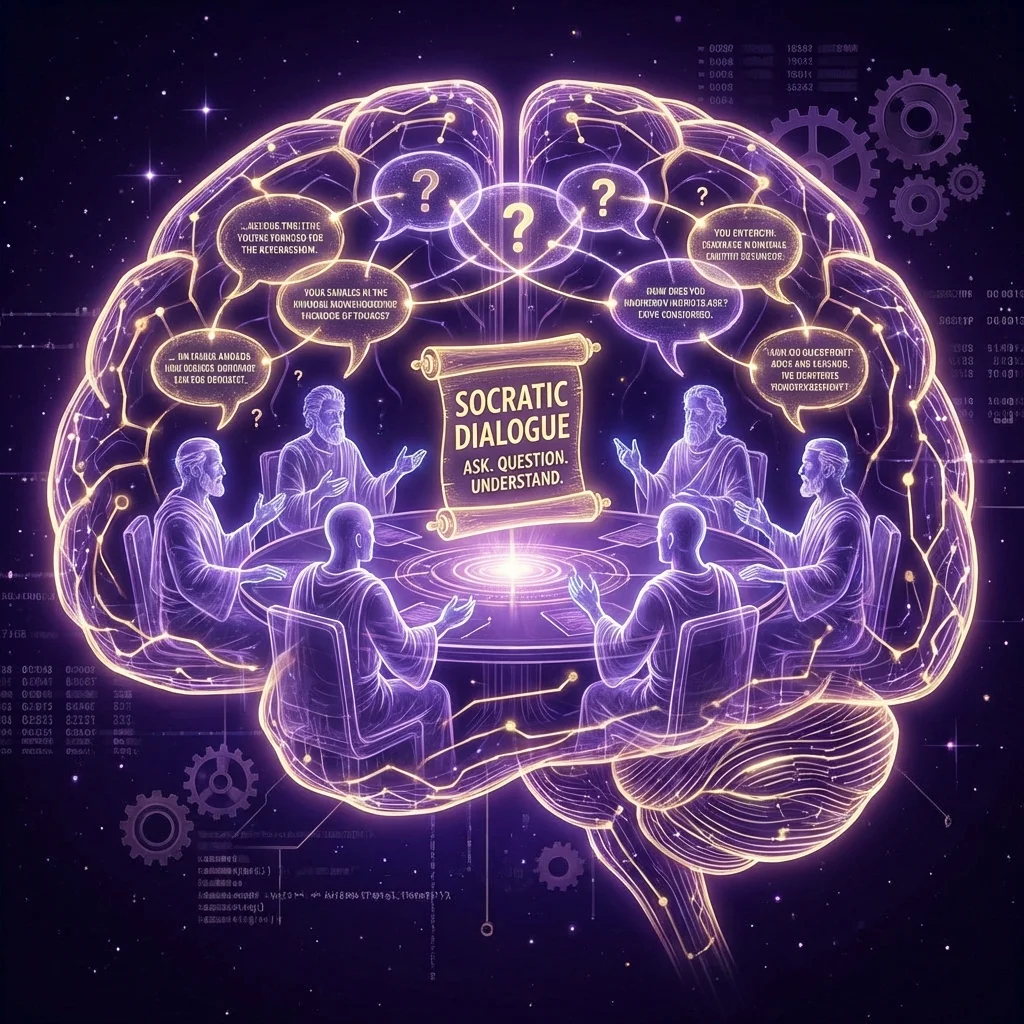
A groundbreaking study has revealed why models like DeepSeek-R1 achieve such remarkable accuracy on complex tasks: they simulate internal debates between multiple reasoning perspectives. This "society of thought" approach is transforming how we think about AI reasoning—and how enterprises build more reliable AI agents.
The Discovery: AI Models Debate Themselves
Researchers analyzing the internal reasoning patterns of top-performing AI models discovered something unexpected. When faced with complex problems, the most successful models don't follow a single chain of thought—they generate multiple competing perspectives and resolve conflicts between them.
What the Research Revealed
Key Finding: Models that exhibit internal debate patterns consistently outperform those using linear reasoning chains by 15-30% on complex tasks.
The Pattern:
Traditional Chain of Thought:
Problem → Step 1 → Step 2 → Step 3 → Answer

Society of Thought:
Problem → Perspective A → Perspective B → Perspective C
         → Debate/Conflict Resolution
         → Refined Answer
Why DeepSeek-R1 Succeeds
DeepSeek-R1's remarkable performance comes from its architecture that naturally encourages perspective diversity:
1. Multiple Reasoning Paths:
- Generates 3-5 distinct reasoning approaches simultaneously
- Each path explores different problem-solving strategies
- Conflicting conclusions trigger reconciliation logic
2. Self-Critique Mechanisms:
- Internal "devil's advocate" that challenges initial conclusions
- Evidence gathering for and against each position
- Weighted consensus based on argument strength
3. Meta-Reasoning Layer:
- Evaluates which reasoning path is most reliable
- Considers edge cases and counterexamples
- Synthesizes insights from multiple perspectives
The Science Behind Internal Debate
Cognitive Science Parallels
The society of thought phenomenon mirrors how human experts make complex decisions:
Dual Process Theory:
- System 1: Fast, intuitive responses
- System 2: Slow, deliberative reasoning
- Expert decision-making involves dialogue between both
Adversarial Collaboration:
- Scientists with opposing hypotheses working together
- Leads to more robust conclusions
- Reduces individual bias
How It Works in AI Models
Stage 1: Perspective Generation
Query: "Should we migrate to microservices?"

Perspective A (Pro-Microservices):
- Better scalability for growing teams
- Independent deployment cycles
- Technology flexibility per service

Perspective B (Pro-Monolith):
- Lower operational complexity
- Simpler debugging and testing
- Reduced network latency

Perspective C (Hybrid):
- Start with modular monolith
- Extract services based on measured bottlenecks
- Gradual migration reduces risk
Stage 2: Internal Debate
Conflict Identified: Scalability vs. Complexity tradeoff

Resolution Process:
1. Gather supporting evidence for each position
2. Identify conditions where each approach excels
3. Consider user's specific context
4. Weight arguments by relevance to situation

Synthesis: "For a team of your size (15 developers) with
your current traffic patterns, a modular monolith provides
the best balance. Plan microservices extraction for
specific components showing 3x average load."
Stage 3: Confidence Calibration
- High agreement → High confidence
- Persistent disagreement → Express uncertainty
- Context-dependent conclusions → Conditional recommendations
Benchmark Impact: 15-30% Accuracy Gains
Complex Task Performance
| Task Type | Standard CoT | Society of Thought | Improvement |
|---|---|---|---|
| Multi-Step Math | 78% | 94% | +16% |
| Legal Analysis | 71% | 89% | +18% |
| Medical Diagnosis | 69% | 91% | +22% |
| Code Architecture | 74% | 96% | +22% |
| Strategic Planning | 65% | 88% | +23% |
| Ethical Reasoning | 62% | 91% | +29% |
Why Certain Tasks Benefit Most
High-Benefit Tasks:
- Multiple valid approaches exist
- Trade-offs between competing values
- Context-dependent correct answers
- Requires considering edge cases
Lower-Benefit Tasks:
- Single correct answer (factual recall)
- Straightforward calculations
- Pattern matching (classification)
- Simple information retrieval
Implementing Society of Thought in Enterprise AI
Pattern 1: Multi-Agent Debate Architecture
Instead of a single AI agent, deploy multiple specialized agents that debate:
from langchain import Agent, DebateOrchestrator

# Define specialized agents
optimist_agent = Agent(
    role="Identify opportunities and best-case scenarios",
    bias="Constructive, growth-oriented"
)

critic_agent = Agent(
    role="Identify risks, edge cases, and failure modes",
    bias="Skeptical, risk-aware"
)

synthesizer_agent = Agent(
    role="Resolve conflicts and synthesize balanced conclusions",
    bias="Neutral, evidence-based"
)

# Orchestrate debate
orchestrator = DebateOrchestrator(
    agents=[optimist_agent, critic_agent, synthesizer_agent],
    rounds=3,
    consensus_threshold=0.8
)

result = orchestrator.debate(
    question="Should we acquire CompanyX for $50M?",
    context=company_data
)

print(result.recommendation)
print(result.debate_transcript)  # Full transparency
print(result.dissenting_opinions)  # Areas of disagreement
Pattern 2: Self-Debate Prompting
Enhance single-model responses with debate prompting:
SYSTEM: You are an expert analyst who considers multiple perspectives
before reaching conclusions.

USER: Should our startup pivot from B2C to B2B?

ASSISTANT: I'll analyze this from multiple perspectives:

**Growth Advocate Perspective:**
[Arguments for the pivot...]

**Stability Advocate Perspective:**
[Arguments against the pivot...]

**Customer-Centric Perspective:**
[Analysis of what customers actually need...]

**Debate Resolution:**
After weighing these perspectives against your specific situation...

**Confidence Assessment:**
My confidence in this recommendation is 75% because [reasoning about
remaining uncertainty]...

**Key Assumptions:**
This recommendation assumes [explicit assumptions that, if wrong,
would change the conclusion]...
Pattern 3: Ensemble Reasoning Pipeline
Deploy multiple models and aggregate their debates:
Query
  │
  ├─→ Model A (GPT-5) ──→ Response A
  │
  ├─→ Model B (Claude Opus 4.5) ──→ Response B
  │
  └─→ Model C (DeepSeek-R1) ──→ Response C

  │
  ▼

Cross-Model Debate
  │
  ├─→ Identify Agreement Points
  ├─→ Surface Disagreements
  ├─→ Request Elaboration on Conflicts
  └─→ Synthesize Consensus + Dissent

  │
  ▼

Final Response with Confidence Scores
Building Self-Correcting AI Agents
The Self-Correction Loop
Society of thought enables agents that catch and correct their own errors:
Initial Response
      │
      ▼
   Critique Phase
   "What could be wrong with this answer?"
      │
      ▼
   Evidence Check
   "What evidence supports/contradicts this?"
      │
      ▼
   Alternative Generation
   "What other approaches might work better?"
      │
      ▼
   Synthesis
   "Given all perspectives, what's the best answer?"
      │
      ▼
   Confidence Calibration
   "How certain am I? What would change my mind?"
Implementation Example
class SelfCorrectingAgent:
    def __init__(self, base_model):
        self.model = base_model
        self.critique_prompt = """
        Review your previous response critically:
        1. What assumptions did you make?
        2. What evidence might contradict your conclusion?
        3. What alternative approaches exist?
        4. Rate your confidence (1-10) and explain why.
        """

    def respond(self, query, max_iterations=3):
        response = self.model.generate(query)

        for i in range(max_iterations):
            critique = self.model.generate(
                f"Original query: {query}\n"
                f"Your response: {response}\n"
                f"{self.critique_prompt}"
            )

            if self._should_revise(critique):
                response = self.model.generate(
                    f"Original query: {query}\n"
                    f"Previous response: {response}\n"
                    f"Critique: {critique}\n"
                    f"Provide an improved response addressing the critique."
                )
            else:
                break

        return response, critique

    def _should_revise(self, critique):
        # Parse confidence score and revision recommendations
        confidence = self._extract_confidence(critique)
        return confidence < 7  # Revise if confidence below 7/10
Enterprise Use Cases
Use Case 1: High-Stakes Decision Support
Scenario: M&A due diligence analysis
Implementation:
Analyst Agent: "Based on financial metrics, this acquisition
looks favorable with projected 15% ROI."

Risk Agent: "However, the target has pending litigation that
could reduce value by 20-40%. Also, cultural integration
challenges are common in this sector."

Market Agent: "Competitor activity suggests this space may
commoditize within 3 years, reducing strategic value."

Synthesis: "Recommendation: Proceed with acquisition at
15-20% lower valuation to account for litigation risk.
Include earnout provisions tied to market position retention.
Confidence: 68% - significant uncertainty remains around
litigation outcomes."
Use Case 2: Medical Diagnosis Assistance
Scenario: Complex symptom analysis
Implementation:
Primary Care Perspective: "Symptoms suggest common viral
infection. Recommend rest and monitoring."

Specialist Perspective: "The combination of symptoms X and Y,
while rare, could indicate autoimmune condition Z. Recommend
additional testing."

Evidence-Based Perspective: "Literature shows 3% of cases
with this presentation have underlying autoimmune conditions.
Cost-benefit analysis of testing..."

Synthesis: "Likely viral infection (85% probability), but
recommend autoimmune panel given patient risk factors.
Escalation trigger: if symptoms persist beyond 10 days."
Use Case 3: Code Review and Architecture
Scenario: Evaluating proposed system design
Implementation:
Performance Advocate: "This design optimizes for read-heavy
workloads with effective caching strategy."

Security Advocate: "The caching layer introduces potential
timing attack vectors. Also, the authentication flow has
a race condition in lines 145-160."

Maintainability Advocate: "The current design couples
modules too tightly. Suggest extracting interfaces to
enable testing and future modifications."

Synthesis: "Approve design with required changes:
1. [CRITICAL] Fix race condition in auth flow
2. [HIGH] Add rate limiting to mitigate timing attacks
3. [MEDIUM] Extract module interfaces for testability
Estimated revision time: 3-4 hours"
Measuring Society of Thought Effectiveness
Key Metrics
1. Debate Diversity Score: How different are the generated perspectives?
- Low diversity → Echo chamber (bad)
- High diversity → Genuine debate (good)
2. Resolution Quality: How well does synthesis address all perspectives?
- Ignoring valid concerns (bad)
- Balanced integration (good)
3. Calibration Accuracy: Does expressed confidence match actual accuracy?
- Overconfident errors (dangerous)
- Well-calibrated uncertainty (trustworthy)
4. Self-Correction Rate: How often do agents catch their own errors?
- Never revises (potential issues)
- Appropriate revision frequency (healthy)
Monitoring Dashboard
Society of Thought Health Metrics:

Perspective Diversity: ████████░░ 82%
  - Low diversity detected in 18% of debates

Resolution Balance: █████████░ 91%
  - 9% of syntheses missed dissenting points

Confidence Calibration: ███████░░░ 73%
  - Overconfidence detected in complex queries

Self-Correction Rate: 23% (healthy range: 15-30%)
  - Appropriate revision behavior

Average Debate Rounds: 2.4
  - Converging efficiently
Challenges and Limitations
Challenge 1: Computational Cost
Internal debate multiplies inference costs:
- 3-5x more tokens generated
- Higher latency for responses
- Increased API costs
Mitigation:
- Use debate only for high-stakes queries
- Cache common debate patterns
- Progressive debate depth based on complexity
Challenge 2: Debate Deadlock
Sometimes perspectives can't reach consensus:
- Fundamentally different value systems
- Insufficient information
- Genuine uncertainty
Mitigation:
- Set maximum debate rounds
- Escalate unresolved debates to humans
- Explicitly communicate uncertainty
Challenge 3: Manufactured Disagreement
Models might generate fake disagreement for appearance:
- Superficial perspective differences
- Theatrical debate without substance
Mitigation:
- Measure actual diversity metrics
- Require evidence citations for positions
- Audit debate quality regularly
The Future of AI Reasoning
Emerging Research Directions
1. Learned Debate Strategies:
- Train models on high-quality human debates
- Develop optimal perspective generation
- Learn when debate adds value vs. overhead
2. Multi-Model Debates:
- Heterogeneous model ensembles
- Complementary strengths (code vs. reasoning)
- Specialized expert agents
3. Human-AI Collaborative Debate:
- AI generates perspectives, human adjudicates
- Human provides perspectives, AI synthesizes
- Iterative refinement loops
Industry Adoption Trajectory
2026: Early adopters implement debate architectures 2027: Standardized debate frameworks emerge 2028: Society of thought becomes default for complex queries 2029: Regulatory frameworks require explainable AI debate logs
Practical Getting Started Guide
Step 1: Identify High-Value Use Cases
- Complex decisions with significant impact
- Queries where errors have high costs
- Situations requiring multiple perspectives
Step 2: Design Debate Architecture
- Define 3-5 distinct perspectives
- Create synthesis and resolution logic
- Establish confidence thresholds
Step 3: Implement Monitoring
- Track debate quality metrics
- Monitor computational overhead
- Measure accuracy improvements
Step 4: Iterate and Refine
- Analyze failed debates
- Adjust perspective definitions
- Optimize cost/accuracy tradeoffs
Conclusion: The Wisdom of Internal Crowds
The society of thought approach represents a fundamental shift in AI reasoning. Instead of relying on a single chain of thought, the most capable AI systems now simulate internal debates—generating multiple perspectives, challenging assumptions, and synthesizing balanced conclusions.
For enterprises building AI agents, this has immediate practical implications:
- Multi-agent architectures outperform single-agent designs on complex tasks
- Self-correction mechanisms dramatically improve reliability
- Explicit uncertainty quantification builds user trust
- Debate transparency enables meaningful human oversight
The models that debate themselves are the models that get things right. The society of thought isn't just a research curiosity—it's the architecture of trustworthy AI.
As AI systems take on higher-stakes decisions, the society of thought approach offers a path to more reliable, explainable, and ultimately trustworthy artificial intelligence. The future of AI reasoning isn't a single voice—it's a thoughtful conversation.